

How to Center Yourself
What is Centering yourself and how can this benefit you?
Centering is the process of accessing an internal state of consciousness that is neutral, calm, steady, alert, active, and present.
Many exercises, practices, and methods support centering.
Any exercise or method that brings you to a state of “at-homeness” within yourself can be considered a centering practice.
The Center doesn’t have a physical location, yet it is associated with specific body regions. It’s more of a dynamic point of psychic equilibrium or inner balance.
When you’re in the Center, there’s no internal resistance. Everything simply is.
You are alive, alert, and active. An inner calm prevails.
Abiding in the present moment, you act spontaneously. You don’t try to achieve this present awareness; it’s a result of being in the Center.
Happiness and sadness are not experienced in the Center. You don’t feel “positive” or “negative.”
In the Center, you are neutral.
Most of us are out of the Center all the time.
Our search for happiness is a consequence of being out of the Center.
We strive for success or to “build self-confidence” largely because our Center eludes us.
Other symptoms of being off-center include addictive behaviors, being overwhelmed, laziness, procrastination, a fixed mindset, and self-criticism.
When we’re outside the Center, we either lack trust in ourselves or are overly confident in our mind’s perception.
Gurus, thought leaders, talking heads, “officials,” and institutions become our authority.
The truth is, when we’re out of the Center, we can’t trust ourselves because we’re disconnected from our instincts and our true feelings.
We experience all inner fulfillment from the Center.
When we don’t abide there, we feel impoverished. This forces us to look to the future or ruminate in the past.
We believe the answer lies in something external: a better job, the “right” relationship, more money, prestige, and so on.
When we’re out of the Center, fear, anxiety, anger, rigidity, or numbness rules us.
Clear Indicators You’re Out of Center
Throughout the day, you …
Take on too many tasks, and you multitask
Are reactive, checking your phone compulsively
Fail to differentiate what is urgent from what’s important
Feel fatigued early in the day
In your mental and emotional state, you …
Are consumed by negative self-talk
Are easily distracted and unable to focus
Ruminate about the past or hold anxiety about the future
Get stuck, high-strung, or overwhelmed
In the evening, you …
End your day feeling depleted
Struggle with impulse control with sugar, social media, alcohol, snacks, TV, marijuana, drugs, shopping, etc
Can’t remember what you did yesterday or even today
Go to sleep too late or crash too early
How to Center Yourself: The Basic Process
Notice when you’re out of the Center, and then
Do a transformative practice that helps center you.
Noticing when you’re out of the Center is half the battle. We experience most of our lives without much consciousness (being out of the center).
How to Center Yourself: 12 Transformative Exercises
Tune the Breath: Breathe Properly
When you’re out of Center, one thing is sure: you’re not breathing properly.
When your mind is racing, your breath is coarse.
Observe your breathing. Don’t try to change anything; simply observe the involuntary process of breathing. Let the mind follow the body, not vice versa.
Witnessing the process of breathing, allow your awareness to sink into your lower torso gently.
Just 3 or 4 breaths can sometimes help bring you closer to the Center. But the longer you can neutrally observe the breath, the more you can tune it.
Zhan Zhuang: Stand Like a Tree
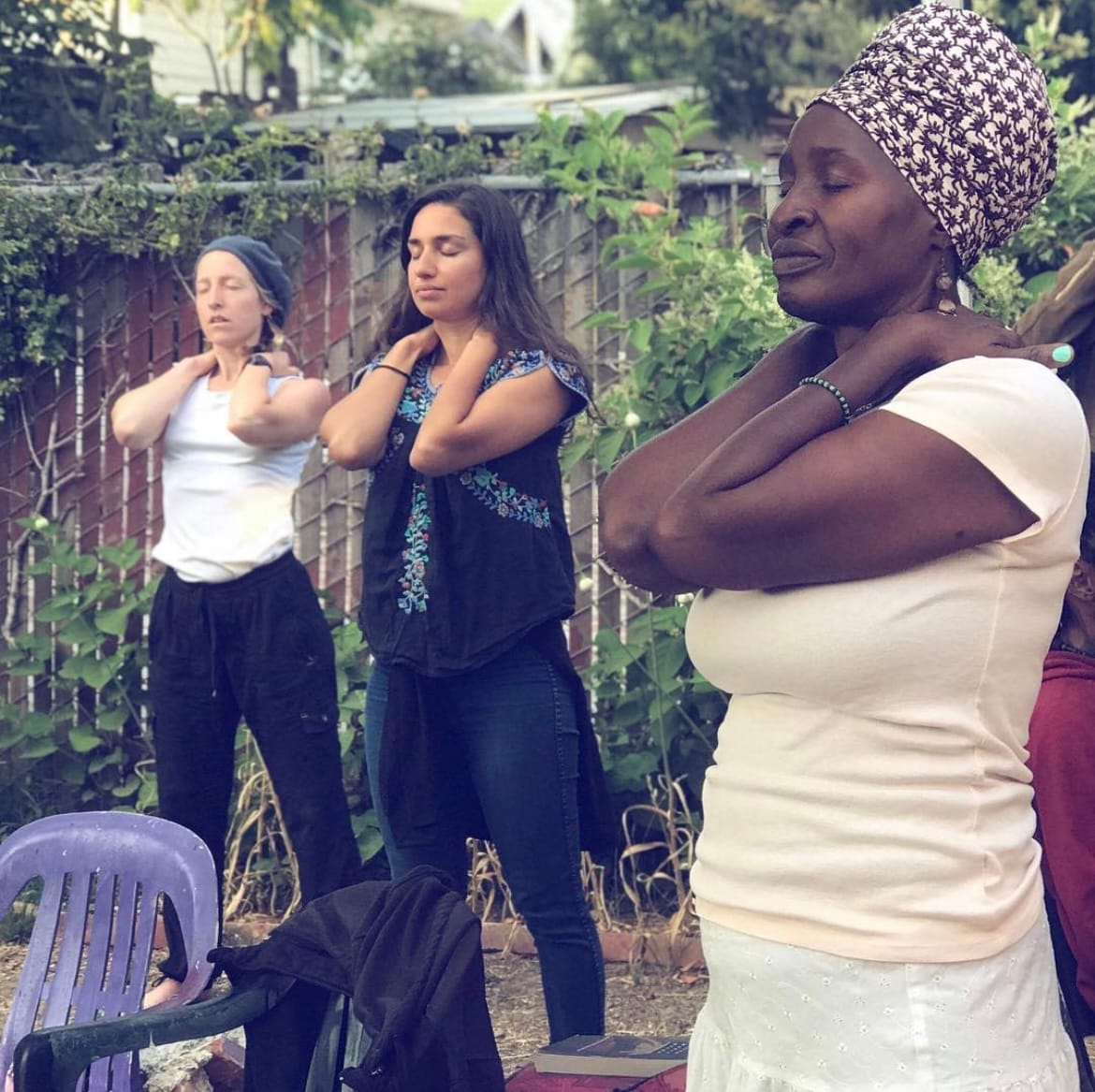
This is one of the most effective ways of centering yourself. Stand like a tree with your feet shoulder-width apart and your spine straight.
Imagine a cord extending from the crown of your head into the sky.
There are several variations of this practice:
Variation #1: Place both of your hands over your navel. While your head is “floating” above your body, allow the rest of your body to relax and sink (internally).
Variation #2: Imagine that you’re a tree. Your head, arms, hands, and fingers are the branches. Your legs and torso form the trunk. And your feet sprout roots far down beneath the ground. Feel how heavy your feet get as they take root.
For these practices, stand with your eyes mostly closed for one to two minutes.
This is a highly modified version of an ancient standing practice called Zhan Zhuang.
Feel Your Feet: Sink Your Awareness
When you’re scattered, anxious, and distracted, you’re often overthinking.
Too much energy is swirling in your head, so it helps to redistribute that energy.
To do so, put both feet firmly on the ground. Place your full awareness on the bottom of your feet.
This helps draw the excessive energy down into your body.
Pay attention to any sensations in your feet. This practice often works within a minute or two.
Belly Bliss: Attention on Your Navel
In Qigong and Tai Chi, the center of your body is the lower dantien, about two finger widths below your navel (within the torso, not at the outer skin level).
Place your awareness in this area and breathe naturally.
Sometimes it’s helpful to put one or both hands over your navel as you breathe.
Combine this with conscious breathing practice (above) for greater benefit.
You’ll probably notice the effects within 30 seconds to 1 minute.
Heart Centering: Attention on Your Heart
Your heart works tirelessly all day and night for you, yet you likely give it little attention.
Place your awareness on your heart region as you breathe naturally.
Smile inwardly at your heart. Acknowledge your heart on the inhale, saying, “I see you.”
And then express gratitude to your heart on the exhale, saying, “Thank you.”
Repeat this five times.
Establish a Plumb Line: Attention on Your Third Eye
To construct a vertical wall or a door jam without using a level, carpenters must first establish a plumb line.
A plumb line is a straight vertical line. There’s a plumb line in the body, too.
In an upright seated position, gaze with both eyes at the tip of your nose.
As you do this, place your awareness on your “third eye” region in the center of your forehead, about an inch above your brow.
This practice may require some trial and error, but you’ll know when you’ve got it.
Once you do, you can establish a plumb line quickly whenever you need it.
Call Forth the Observer: Attention Above the Crown
When there’s chaos on the surface, sometimes you need to seek higher ground.
When you are out of sorts, place your awareness about six inches above the crown of your head.
Take the position of an observer, or internal Sage, and watch your thoughts, feelings, and sensations.
This is a powerful practice. It can instantly provide space between the Self (host) and whatever drama might be happening in your ego (guests).
Maintain this observer perspective for as long as it’s comfortable for you.
Access the King: Pyramid Visualization
This practice comes from neo-Jungian psychologist Robert Moore and mythologist Douglas Gillette.5
The King is a powerful archetype in our psyche that represents an organizing principle of the Self.
Visualize a crystal pyramid. A pyramid is a symbol associated with this sacred King.
Imagine a crystalline pyramid in your heart area or a larger pyramid encompassing your entire body.
Feel the invincible, eternally durable presence of this pyramid. Hold this image until you are more centered.
Alternatively, you can try accessing King energy by seeking spiritual guidance through prayer.
Find Stillness in Movement: Mindful Walking
Sometimes, standing or sitting still can exacerbate your internal chaos. In such cases, mindful walking can serve you well.
Start by walking at a comfortable pace.
Stay fully present with every step. Pay attention to your breathing or your body’s movements, rather than the mind’s chatter.
Over time, you’ll notice that your pace will slow, as will the volume and intensity of the mind’s chatter.
Try this for at least ten minutes, or longer if you find it enjoyable.
When possible, walk in nature to further assist the centering process.
Capture What Troubles You: Journaling
To use journaling to help you feel more centered, write about your current challenges: problems, fears, upsets, insecurities, and indignations.
Dump it all in your journal. Expressing your emotions can help them dissipate, allowing you to find your center.
Sometimes, you can become more centered in just a matter of minutes. At other times, you may need to journal for longer periods.
Grounding Exercise: Hold Your Crown
When you’re off-kilter, place one hand directly over the crown of your head. It will help ground you more quickly.
Try this in combination with any of the above methods.
Keep your hand there until you are more grounded, usually a minute or two.
SUMMARY:
The Center is a dynamic point of equilibrium within each of us.
There are four primary centers of intelligence:
A physical center below the navel,
An emotional center in the heart region,
A mental center in the brain region,
And a psycho-spiritual center near the crown of the head.
Accessing any of these centers brings you to the present.
When you center yourself, you feel more alive, alert, present, and resourceful.
Centering is a skill. Once you know how to center yourself, you can access the Center when needed.
To center yourself:
Identify when you’re out of the Center, and
Use a method to return to it.
Rinse and repeat.